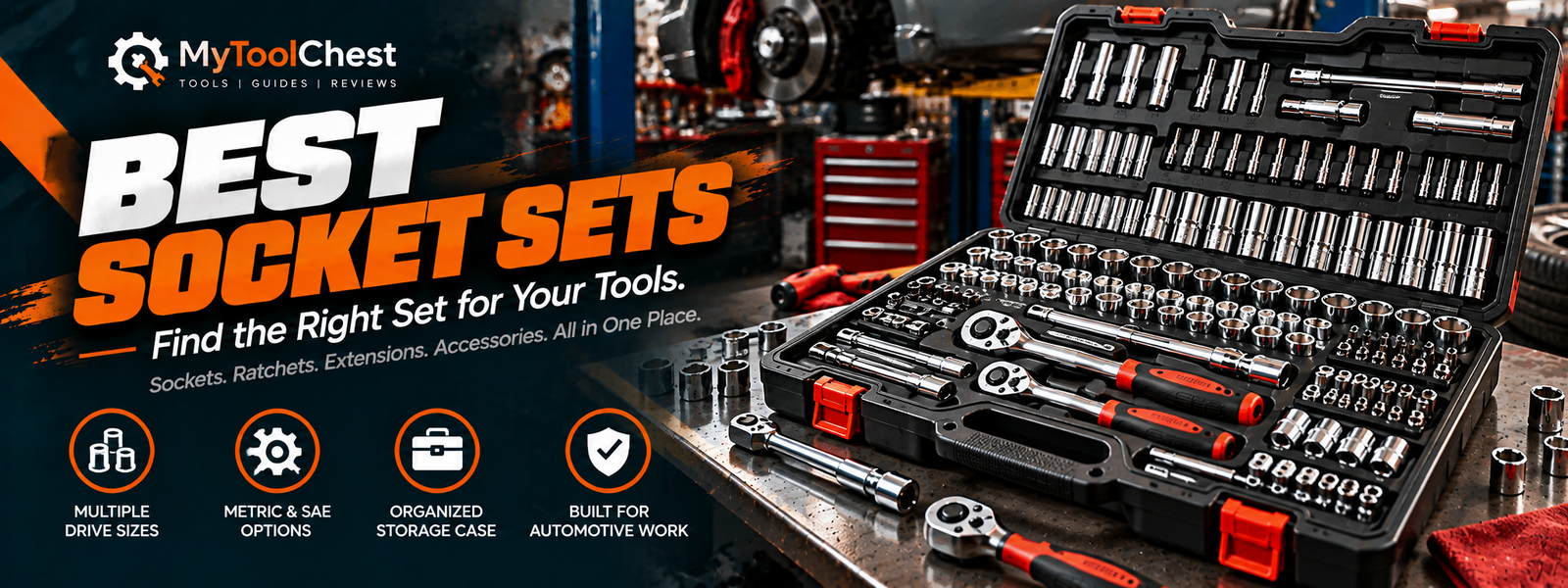
Best Socket Sets: Find the Right Set for Your Tools
A socket set covers one of the most common jobs in any repair: turning nuts and bolts. The right set matches your drive size, size system, and socket depth to the work you actually do, without padding the count with sizes you will never use.
This guide covers the main types of socket sets, how drive sizes differ, and what to check before buying.
Quick Picks by Category
These editorial categories cover the most common ways readers shop for socket sets. Product details are added after verification.
[Product Name — Verify]
Best for: General automotive work
Key specs: [Socket count, drive sizes, coverage — verify]
- Pros: [Verify]
- Cons: [Verify]
[Product Name — Verify]
Best for: Entry-level use
Key specs: [Socket count, drive sizes — verify]
- Pros: [Verify]
- Cons: [Verify]
[Product Name — Verify]
Best for: Metric vehicles
Key specs: [Size range, drive sizes — verify]
- Pros: [Verify]
- Cons: [Verify]
[Product Name — Verify]
Best for: SAE equipment
Key specs: [Size range, drive sizes — verify]
- Pros: [Verify]
- Cons: [Verify]
[Product Name — Verify]
Best for: Studs & recessed nuts
Key specs: [Deep socket count, drive sizes — verify]
- Pros: [Verify]
- Cons: [Verify]
[Product Name — Verify]
Best for: Shop use
Key specs: [Coverage, drive sizes, count — verify]
- Pros: [Verify]
- Cons: [Verify]
[Product Name — Verify]
Best for: Impact wrenches
Key specs: [Impact-rated, drive sizes — verify]
- Pros: [Verify]
- Cons: [Verify]
[Product Name — Verify]
Best for: Small vehicles & travel
Key specs: [Socket count, case size — verify]
- Pros: [Verify]
- Cons: [Verify]
Compare Socket Sets at a Glance
A general framework. Fill in verified product details once research is complete.
| Product | Best For | Socket Count | Drive Sizes | Measurement System | Shallow / Deep | Included Accessories | Price Range |
|---|---|---|---|---|---|---|---|
| [Product — verify] | General automotive | [Verify] | [Verify] | [Verify] | [Verify] | [Ratchet, extensions — verify] | [Verify] |
| [Product — verify] | Metric vehicles | [Verify] | [Verify] | Metric | [Verify] | [Verify] | [Verify] |
| [Product — verify] | SAE equipment | [Verify] | [Verify] | SAE | [Verify] | [Verify] | [Verify] |
| [Product — verify] | Deep sockets | [Verify] | [Verify] | [Verify] | Deep | [Verify] | [Verify] |
| [Product — verify] | Impact wrenches | [Verify] | [Verify] | [Verify] | [Verify] | [Verify] | [Verify] |
| [Product — verify] | Compact carry | [Verify] | [Verify] | [Verify] | [Verify] | [Verify] | [Verify] |
Types of Socket Sets
Socket sets differ mainly in drive size, socket depth, and measurement system. Understanding the trade-offs helps you decide what to prioritize.
Standard Socket Sets
General-purpose use
Mix of shallow sockets in one or two drive sizes. Common starting point for home and automotive work.
Deep Socket Sets
Studs & recessed fasteners
Longer sockets that reach over studs and clear recessed nuts. Often sold separately from shallow sets.
Metric Socket Sets
Modern vehicles
Metric sizes only. Common for vehicles built to metric standards. Check the size range against your fasteners.
SAE Socket Sets
Older vehicles & equipment
Fractional-inch sizes. Common on older US-built vehicles and certain equipment. Not interchangeable with metric.
Combined Metric & SAE
Mixed collections
Both systems in one set. Larger case, higher cost, but covers vehicles from different eras without a second purchase.
Impact Socket Sets
Impact wrenches
Built for impact tools, not hand ratchets. Do not interchange with standard sockets unless the manufacturer confirms compatibility.
Impact set guideCompact Socket Sets
Small kits & travel
Smaller cases with focused coverage. Good for roadside kits and users with limited storage space.
Socket & Ratchet Kits
Ready-to-use coverage
Sockets bundled with a matching ratchet and usually extensions. The most common format for general automotive work.
Ratchet set guideSpecialized Socket Sets
Specific fasteners
Torx, hex, or other specialty fasteners. Usually focused on specific vehicle systems or assembly types.
Impact-rated sockets are not interchangeable with standard hand sockets. Use each type only with the tools its manufacturer specifies.
How to Choose the Best Socket Set
Drive size, size system, and socket depth decide most socket set choices. These factors help you compare options on equal footing.
Drive Size
1/4", 3/8", and 1/2" drives each suit a different range of work. Sets that include multiple drive sizes cover more ground.
Metric vs. SAE
Match the size system to your vehicle. Metric is standard on most modern vehicles; SAE remains on older equipment.
Size Range & Gaps
Check that common sizes are included. A set missing 10mm or 13mm is less useful than a smaller set that covers them.
Shallow vs. Deep
Shallow sockets work in tight spaces; deep sockets clear studs. Many jobs need both, so check what is included.
6-Point vs. 12-Point
6-point sockets grip more surface area; 12-point sockets are easier to position. Each has trade-offs in fit and access.
Standard vs. Impact
Impact sockets are built for impact tools. Never assume a standard socket can substitute for an impact-rated one.
Ratchet Compatibility
Confirm the ratchet matches the drive size and that it is rated for the torque your work involves. Check tooth count.
Accessories
Extensions, adapters, and universal joints expand what the set can reach. Check which are included vs. sold separately.
Material & Finish
Chrome vanadium and other alloys are common. Finish affects corrosion resistance and how tools clean up.
Case & Organization
Labeled slots and secure latches make the set easier to use. Check how the case holds up when loaded.
Warranty & Value
Confirm the warranty and whether individual sockets can be replaced. A set that can be maintained lasts longer.
Socket count alone does not determine usefulness. A set with fewer sockets in the sizes you actually use beats a larger set with gaps in common sizes.
Drive Size Guide
Drive size refers to the square fitting where the socket attaches to the ratchet. Each drive size is suited to a different range of work.
Small Fasteners & Tight Spaces
Suited to interior trim, small engine work, and confined areas. Lower torque capacity than larger drives.
Everyday General Use
The most common drive size for general automotive work. Balances access with enough torque for most jobs.
Larger Fasteners & Higher Torque
Used for suspension, chassis, and other higher-torque applications. Larger sockets and typically longer handles.
Follow the tool and fastener manufacturer’s specifications for torque limits. Drive size alone does not determine safe working limits.
Metric vs. SAE
The two size systems are not interchangeable. Matching the system to your fasteners prevents rounding and slips.
Metric Sockets
- Measured in millimeters (mm)
- Common on vehicles built to metric standards
- Typical sizes include 8mm through 22mm and beyond
- Often the primary system for modern vehicles
- Not interchangeable with SAE sizes
- Check the range covers the sizes you use
SAE Sockets
- Measured in inches and fractions
- Common on older vehicles and certain equipment
- Typical sizes include 1/4" through 1" and beyond
- Still used on some US-built equipment
- Not interchangeable with metric sizes
- A set with both systems covers the widest range
Six-Point vs. Twelve-Point Sockets
Both shapes are common. The right choice depends on the fastener and the space you are working in.
6-Point Sockets
- Grip more of the fastener’s flat surfaces
- Less likely to round a damaged or tight fastener
- Require more rotation to reposition
- Common in impact socket sets
- Good choice for stubborn or worn fasteners
12-Point Sockets
- Easier to position in tight spaces
- Require less rotation to engage the next flat
- Contact less of the fastener than 6-point
- Common in general-purpose sets
- Useful where access is limited
Neither shape is universally better. Choose based on the fastener condition and the access your job allows.
Common Buying Mistakes
- Choosing by socket count alone. A high count can hide gaps in common sizes. Read the contents list before comparing.
- Ignoring metric or SAE coverage. Buying the wrong system leaves you without the sizes your vehicle needs. Confirm the size system first.
- Buying the wrong drive size. A 1/4" set will not replace a 1/2" set on larger fasteners. Match drive size to your work.
- Overlooking deep sockets. Deep sockets are needed for studs and recessed nuts. Check whether the set includes them.
- Assuming impact and standard sockets are interchangeable. Impact sockets are built for impact tools. Do not substitute unless the manufacturer confirms it.
- Ignoring ratchet and accessory compatibility. Extensions, adapters, and universal joints must match the drive size of the sockets.
- Buying duplicate sizes while missing useful ones. A set with repeated sizes and gaps is less useful than a smaller set with better coverage.
- Choosing a case that does not keep sockets organized. Loose sockets waste time and get lost. Check the case layout before buying.
Related Buying Guides
Each guide goes deeper on one tool type. Pick the one closest to your setup.
Tool Sets Hub
The main hub for tool set types, uses, and buying guides.
Open the hubBest Mechanic Tool Sets
Broad automotive and shop coverage in one organized case.
Read the guideBest Ratchet Sets
Ratchet handles paired with sockets for repeated work.
Compare ratchet setsBest Impact Socket Sets
Impact-rated sockets for use with impact wrenches and drivers.
Compare impact setsBest Combination Wrench Sets
Open-end and box-end coverage for turning and holding.
Explore wrench setsBest Automotive Tool Kits
Portable kits for vehicle maintenance and roadside needs.
Find automotive kitsFrequently Asked Questions
What is the best socket set?
There is no single best set. The right one depends on your vehicle, the size system it uses, and the drive sizes your jobs call for. Focus on size coverage and included accessories rather than looking for a universal answer.
Should I choose metric or SAE sockets?
Match the size system to the vehicles you work on. Metric is standard on most modern vehicles, while older US-built equipment often uses SAE. If your work spans both, a set that includes both systems avoids buying a second kit later.
What drive size should I buy first?
3/8" drive is the most common general-purpose starting point for automotive work. It balances access and torque for many jobs. Adding 1/4" for tight spaces and 1/2" for larger fasteners expands what you can handle.
What is the difference between deep and shallow sockets?
Shallow sockets are shorter and work in tight spaces. Deep sockets are longer and reach over studs or clear recessed nuts. Many jobs need both depths, so check what the set includes.
Are six-point sockets better than twelve-point sockets?
Neither is universally better. 6-point sockets grip more of the fastener and are less likely to round a damaged nut, while 12-point sockets are easier to position in tight spaces. Choose based on the fastener and the access your job allows.
Can I use standard sockets with an impact wrench?
Not unless the manufacturer explicitly confirms compatibility. Impact sockets are built for impact tools, and using standard sockets on an impact wrench can cause damage or injury. Follow the tool and socket manufacturer’s guidance.
How many pieces should a socket set have?
Piece count is not a reliable quality signal. A set with fewer sockets in the sizes you actually use beats a larger set with gaps in common sizes. Read the contents list rather than comparing counts alone.
Is a socket set different from a mechanic tool set?
Yes. A socket set focuses on sockets, usually with a ratchet and extensions. A mechanic tool set is broader and typically includes sockets, ratchets, wrenches, and sometimes drivers or hex keys. See our mechanic tool sets guide for the wider category.
Product Data Verification
This guide currently uses placeholders for product names, specifications, and retailer links.
Before Publishing
- Replace every [Verify before publication] field with confirmed product details.
- Confirm each product still exists and matches its category.
- Verify retailer links resolve and point to the correct listing.
- Confirm specifications match the manufacturer’s current published data.
- Do not publish prices, ratings, or test results that have not been verified.
- Confirm socket counts, drive sizes, and metric/SAE coverage directly from the manufacturer.
- Confirm impact-rated sockets are labeled as such by the manufacturer before listing them in that category.
Find the Socket Set That Fits Your Work
A socket set earns its place when it covers the sizes you actually use, matches your drive size, and keeps sockets organized in a case that holds up. Check the contents list, confirm the size system, and plan for the depths your jobs need. Then use the related guides below to compare specific categories.