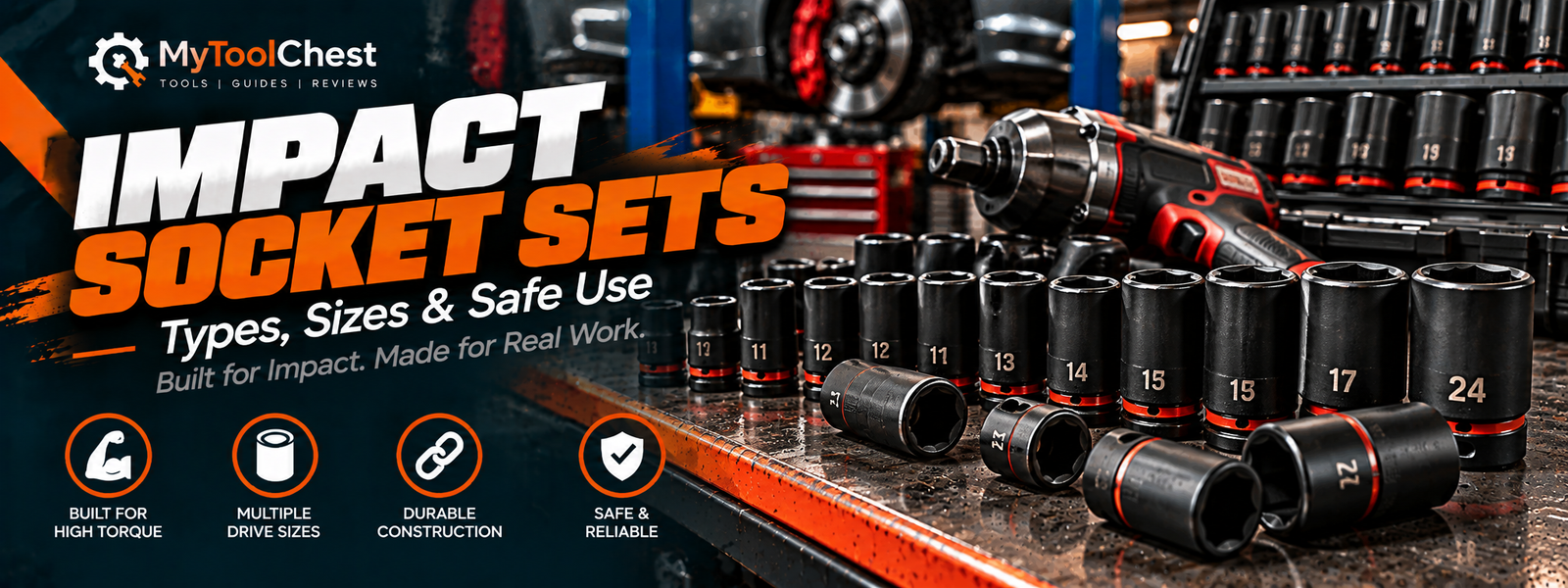
Impact Socket Sets: Types, Sizes & Safe Use
Impact sockets are built for use with powered impact tools, not hand ratchets. They look similar to standard sockets, but their construction, finish, and intended use are different. Matching drive size, socket depth, and retention system to the tool is what keeps the work safe and the sockets intact.
This is an educational guide to what impact socket sets are, how they differ from standard sockets, and how to use them correctly.
On This Page
Jump straight to the section you need. Every link scrolls to a section on this page.
What Is an Impact Socket Set?
An impact socket set is a group of sockets designed for use with impact wrenches and other powered impact tools, which apply rapid rotational impacts rather than steady turning force.
- Designed for impact tools Impact sockets are made for powered impact wrenches and drivers, which deliver torque through repeated impact pulses rather than steady pressure.
- Different construction from many hand sockets Construction and finish are usually chosen to absorb impact and resist cracking. Exact materials vary by manufacturer.
- Fit and compatibility matter The socket drive must match the tool drive, and the socket must be rated for impact use. Never assume compatibility from appearance alone.
- Retention system matters Impact tools often use a pin or ring to hold the socket on the drive. The socket and tool retention methods need to match.
- Not interchangeable with every socket type Impact sockets are not a universal substitute for standard sockets, and standard sockets are not a universal substitute for impact sockets.
Impact Sockets vs. Standard Sockets
The two categories are built for different tools. Neither replaces the other. Actual suitability depends on manufacturer specifications.
| Feature | Impact Sockets | Standard Sockets |
|---|---|---|
| Intended tool use | Powered impact wrenches and impact drivers | Hand ratchets, breaker bars, and hand drivers |
| Construction considerations | Built to absorb repeated impact pulses without cracking; exact material and heat treatment vary by manufacturer | Built for steady turning force; construction optimized for hand tools |
| Finish and appearance | Often a matte or black finish; color alone does not prove impact rating | Commonly chrome-plated; finish is cosmetic, not a rating |
| Compatibility | Drive size and retention system must match the impact tool | Drive size must match the hand tool; not rated for impact use |
| Inspection and maintenance | Inspect for cracks, deformation, and wear; replace damaged sockets | Inspect for wear and stripping; replace damaged sockets |
| Appropriate applications | Automotive, heavy equipment, and any task with a compatible impact tool | Hand-tool turning where no impact is involved |
Color, finish, or appearance alone does not confirm that a socket is impact-rated. Follow the manufacturer’s published specifications and intended-use guidance.
Common Impact Socket Drive Sizes
Drive size refers to the square fitting where the socket attaches to the tool. Each size suits a different range of fasteners and workspaces.
Compact Applications
Suited to small fasteners and confined areas. Check that the tool and socket are both rated for impact use at this size.
General-Purpose
A versatile middle ground where the tool’s specifications support it. Common for light to medium automotive tasks.
Common Automotive
Widely used for automotive maintenance and other applications involving larger fasteners.
Larger Fastening
Used for larger fastening applications and specialized equipment. Requires matching tool and socket ratings.
| Drive Size | Typical Applications | Common Advantages | Limitations | Compatibility Considerations |
|---|---|---|---|---|
| 1/4-inch | Small fasteners, tight access | Compact size, easy to control | Limited for larger fasteners | Confirm the tool and socket are both impact-rated at this size |
| 3/8-inch | General automotive and light mechanical work | Balances access with useful torque delivery | Not suited to very large fasteners | Match retention system between tool and socket |
| 1/2-inch | Common automotive, suspension, chassis | Common size, wide socket range | Bulkier than smaller drives | Confirm socket depth and retention system |
| 3/4-inch and larger | Heavy equipment, larger fasteners | Handles larger socket sizes and tools | Bulkier and heavier; requires matching tools | Confirm tool and socket are both rated for the intended application |
Follow the tool and socket manufacturer’s guidance for load and intended use. Drive size alone does not determine safe working limits.
Shallow vs. Deep Impact Sockets
Both depths have a place. The right choice depends on the fastener and the clearance around it.
Shallow Impact Sockets
- Shorter overall length
- Better in confined spaces
- Good for fasteners with clearance around them
- Not suited to reaching over studs
- Common in compact tool kits
Deep Impact Sockets
- Longer overall length
- Reaches recessed fasteners and clears studs
- Useful on threaded shafts and long bolts
- Takes more space in storage
- Often paired with shallow sockets in the same set
Many impact socket sets include both depths to cover a wider range of fasteners. Choose the depth that matches your work and clearance.
Metric vs. SAE Impact Sockets
The two size systems are not interchangeable. Matching the system to your fasteners prevents rounding and slips.
Metric Impact Sockets
- Measured in millimeters (mm)
- Common on vehicles built to metric standards
- Typical sizes include 8mm through 24mm and beyond
- Often the primary system for modern vehicles
- Not interchangeable with SAE sizes
- Check the range covers the sizes you need
SAE Impact Sockets
- Measured in inches and fractions
- Common on older vehicles and certain equipment
- Typical sizes include 1/4" through 1" and beyond
- Still used on some US-built equipment
- Not interchangeable with metric sizes
- A set with both systems covers the widest range
Verify the actual size range you need for your tasks. A set that advertises wide coverage may still miss the specific sizes your fasteners require.
Impact Socket Construction
Construction varies between designs and manufacturers. Here is what shapes how impact sockets are made and used.
Material & Heat Treatment
Exact materials and heat treatment are specified by the manufacturer. Do not assume that any single material grade applies across all impact sockets.
Wall Thickness & Design
Walls may be thicker than standard sockets to absorb impact. Design choices vary, and thicker walls reduce access in tight spaces.
Protective Finishes
Common finishes include black oxide and phosphate coatings. Finish affects corrosion resistance and appearance, not impact rating.
Size Markings
Clear markings help identify sizes quickly. Roll-stamped or laser-etched markings are common; legibility matters more than the method.
Retention Systems
Pin or ring retention systems hold sockets on the impact tool. The socket and tool retention methods must match to work properly.
Manufacturer Ratings
Ratings and compatibility instructions come from the manufacturer. Follow them rather than relying on appearance or assumptions.
How to Choose an Impact Socket Set
Match the set to the tool, the fastener, and the work. This checklist covers the factors that matter most.
- Required drive size Start with the impact tool you plan to use. The socket drive must match the tool drive.
- Metric or SAE coverage Match the size system to your fasteners. The two are not interchangeable.
- Shallow & deep requirements Decide whether you need both depths or if one covers your work. Many jobs benefit from both.
- Common socket sizes Check that the set covers the sizes you actually use, not just the total count.
- Tool compatibility Confirm the sockets are rated for impact use and that your tool’s specifications support them.
- Retention system Confirm whether your tool uses a pin, ring, or friction retention, and pick sockets that match.
- Storage & organization A labeled rail or case makes sockets easier to find. Check whether storage keeps sizes separated.
- Clear size markings Legible markings save time when matching a socket to a fastener. Look for markings that will not wear off quickly.
- Manufacturer specifications Ratings and intended-use instructions come from the manufacturer. Read them before use.
- Task fit, not count Choose based on your actual tasks and tool compatibility, not on the total number of pieces.
Socket count alone does not determine usefulness. A smaller set with the sizes and depths your work needs is worth more than a larger set with gaps.
Safe Use and Maintenance
Impact tools deliver force quickly. A few habits reduce the risk of damage, injury, and shortened tool life.
Confirm the socket is rated for impact applications. Standard hand sockets should not be used with impact tools unless the manufacturer explicitly permits it.
Check for cracks, excessive wear, or deformation. Damaged sockets can fail under load and should be replaced rather than reused.
The socket drive must match the tool drive. Mismatched sizes can slip, spin, or damage the socket and tool.
Follow the tool manufacturer’s instructions for the retention system. A socket that is not fully seated can come loose during operation.
Impact tools can throw debris or fragments. Safety glasses or a face shield are appropriate when working with impact equipment.
Operating instructions, speed settings, and torque limits are set by the tool manufacturer. Read them before use.
Homemade adapters and incompatible accessories can fail under impact force. Use only manufacturer-approved accessories.
Wipe sockets after use, keep the retention mechanism clean, and store sockets so they do not bang against each other.
A cracked or deformed socket should be taken out of service. Continuing to use it risks failure under load.
Impact sockets are not a substitute for correct operating procedures. Follow the tool manufacturer’s instructions and use only approved accessories.
Common Mistakes
- Using standard sockets with an impact tool. Hand sockets are not rated for impact use unless the manufacturer explicitly permits it. Choose impact-rated sockets.
- Selecting the wrong drive size. The socket drive must match the tool drive. Mismatched sizes can slip or damage the socket and tool.
- Ignoring metric vs. SAE sizing. Using the wrong size system can round a fastener. Match the system to your vehicle or equipment.
- Using a socket that does not fit the fastener. A loose or oversized socket can slip and damage the fastener. Match the socket to the nut or bolt.
- Assuming finish or color proves impact suitability. A black or matte finish does not by itself confirm impact rating. Check the manufacturer’s published specifications.
- Overlooking retention system compatibility. Pin, ring, and friction retention systems are not interchangeable. Match the socket to the tool.
- Continuing to use damaged sockets. Cracks, deformation, or heavy wear mean the socket should be replaced, not reused.
- Ignoring the tool manufacturer’s instructions. Operating limits, speed settings, and maintenance are set by the manufacturer. Read them before use.
Related Guides
Educational guides that go deeper on related tool categories.
Tool Sets Hub
The main hub for tool set types, uses, and buying guides.
Best Socket Sets
Drive sizes, size coverage, and ratchet-ready layouts.
Ratchet Sets Guide
Types, drive sizes, and how ratchet mechanisms work.
Best Mechanic Tool Sets
Broad automotive and shop coverage in one organized case.
Best Automotive Tool Kits
Portable kits for vehicle maintenance and roadside needs.
Frequently Asked Questions
What is an impact socket set?
An impact socket set is a group of sockets designed for use with impact wrenches and other powered impact tools. They are built to absorb repeated impact pulses, unlike standard hand-tool sockets. Compatibility with the tool drive and retention system matters.
What is the difference between impact sockets and regular sockets?
Impact sockets are designed for powered impact tools and constructed to absorb impact pulses. Standard sockets are designed for hand tools and steady turning force. Finishes and construction differ, and the two are not interchangeable unless the manufacturer explicitly permits it.
Can standard sockets be used with an impact wrench?
Not unless the manufacturer explicitly confirms compatibility. Standard hand sockets are not rated for impact use and can fail under the repeated pulses of an impact tool. Use impact-rated sockets only.
Why are impact sockets often black?
Black oxide and similar finishes are common on impact sockets, but color alone does not determine whether a socket is impact-rated. Check the manufacturer’s published specifications rather than relying on appearance.
What drive size should I use for impact sockets?
The drive size must match the impact tool you plan to use. Common sizes are 1/4-inch, 3/8-inch, and 1/2-inch, with 3/4-inch and larger drives used for heavy equipment and larger fasteners. Match the size to the fastener and confirm the tool supports it.
What is the difference between shallow and deep impact sockets?
Shallow sockets are shorter and work better in tight spaces. Deep sockets are longer and reach over studs or clear recessed fasteners. Many sets include both depths to cover a wider range of work.
Should I choose metric or SAE impact sockets?
Match the size system to your vehicle or equipment. Metric is standard on most modern vehicles, while older US-built equipment often uses SAE. If your work spans both, a set with both systems covers the widest range.
How should impact sockets be inspected and maintained?
Check sockets regularly for cracks, deformation, and heavy wear. Replace damaged sockets rather than reusing them. Keep the retention system clean, wipe sockets after use, and follow the tool manufacturer’s maintenance guidance.
Choose the Right Socket for the Job
Impact sockets are built for impact tools, and standard sockets are built for hand tools. Matching drive size, retention system, and manufacturer ratings to your work keeps both tools and users safer. Use the related guides below to explore the tool categories that go with an impact socket set.