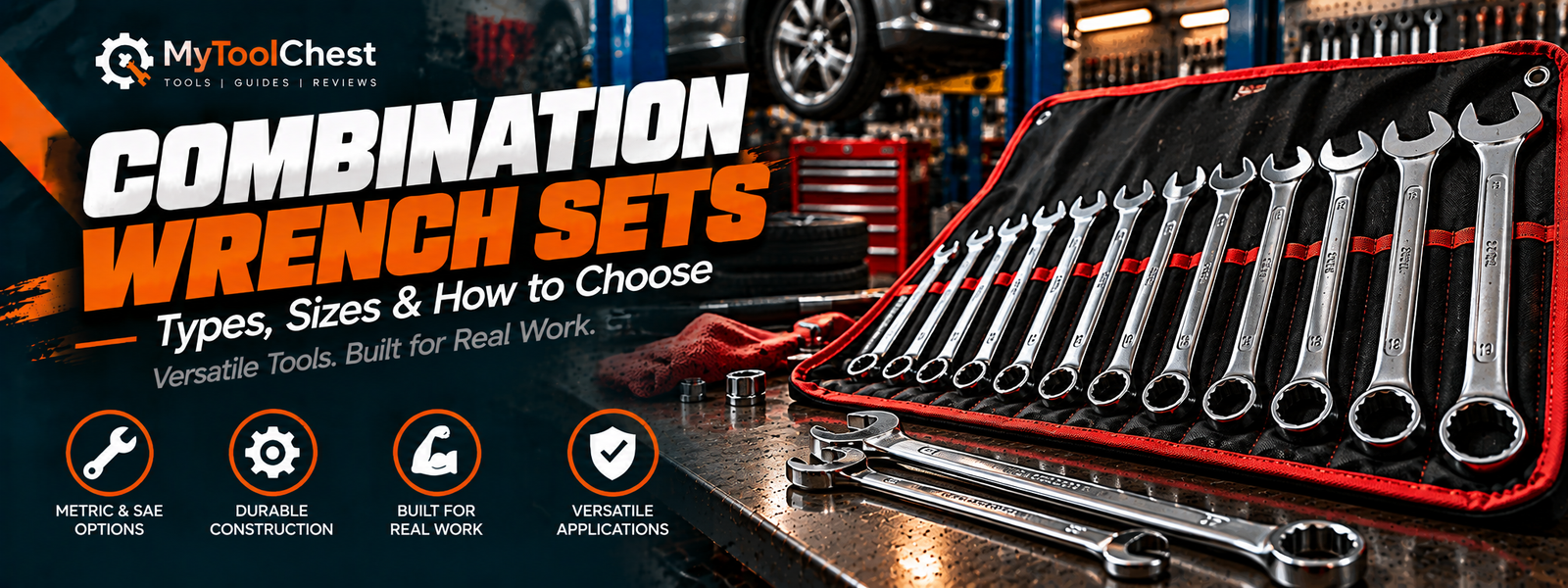
Combination Wrench Sets: Types, Sizes & How to Choose
A combination wrench pairs an open-end jaw on one side with a closed box-end head on the other. That pairing covers two different ways of accessing a fastener in a single tool, which is why it is one of the most common wrench styles in automotive and mechanical work.
This is an educational guide to how combination wrenches work, how their sizes and measurement systems differ, and how to choose a set that fits your tasks.
On This Page
Jump straight to the section you need. Every link scrolls to a section on this page.
What Is a Combination Wrench?
A combination wrench has an open end on one side and a box end on the other, both sized for the same fastener. The two ends serve different access and engagement needs, so one tool covers more situations.
- Open-end jaw A U-shaped opening that slides onto a fastener from the side. Useful where the wrench must reach around an obstruction or onto a fitting with a hose or line attached.
- Box-end head A closed ring with an internal shape that fits fully around the fastener. Engages more of the fastener’s flats, which helps with tight or damaged nuts.
- Two ends, one size Both ends of a combination wrench are sized for the same fastener size, so you can flip the tool without switching to a different wrench.
- Fit matters Wrench size must match the fastener. A loose wrench can slip and round the nut or bolt; the wrong system (metric vs. SAE) can too.
- Common applications Automotive repair, mechanical work, home maintenance, and general workshop tasks — anywhere a fastener needs steady turning force.
Open End vs. Box End
The two ends solve different problems. Neither replaces the other, and the right choice depends on access, fastener condition, and workspace.
Open-End Jaw
- Slides onto the fastener from the side
- Reaches fittings with hoses or lines attached
- Works where a box end cannot clear
- Engages fewer of the fastener’s flats
- Greater risk of slipping under heavy load
- Best where access is the constraint
Box-End Head
- Fully encloses the fastener
- Engages more of the fastener’s flats
- Less likely to slip under load
- Useful on tight or partially damaged nuts
- Requires clearance to fit over the fastener
- Best for high-torque or awkward angles
The right end depends on the fastener, the space around it, and how much torque the job requires. Many tasks switch between the two ends of the same wrench.
Metric vs. SAE Wrenches
The two size systems are not interchangeable. Matching the system to your fasteners prevents rounding and slips.
Metric Wrenches
- Sizes measured in millimeters (mm)
- Common on vehicles built to metric standards
- Typical sizes include 8mm through 22mm and beyond
- Often the primary system for modern vehicles
- Not interchangeable with SAE sizes
- Check the range covers the sizes you need
SAE Wrenches
- Sizes measured in fractions of an inch
- Common on older vehicles and certain equipment
- Typical sizes include 1/4" through 1" and beyond
- Still used on some US-built equipment
- Not interchangeable with metric sizes
- A set with both systems covers the widest range
| Measurement System | Unit | Identification | Practical Considerations |
|---|---|---|---|
| Metric | Millimeters (mm) | Marked with a plain number, such as 10, 13, 17 | Common on modern vehicles and imported equipment |
| SAE | Fractions of an inch | Marked as a fraction, such as 3/8", 1/2", 9/16" | Common on older US-built vehicles and certain equipment |
| Combined | Both mm and fractions | Mixed markings in the same set | Useful when work spans multiple vehicles or mixed equipment |
Verify the actual size range you need for your tasks. A set that advertises wide coverage may still miss the specific sizes your fasteners require.
Common Combination Wrench Sizes
Wrench size refers to the distance across the fastener flats, not the length of the wrench. Both ends of a combination wrench are usually marked for the same size.
How Wrenches Are Labeled
Size is stamped or etched on the wrench body, usually near each end. Metric wrenches show a plain number in millimeters; SAE wrenches show a fraction of an inch.
Check Both Ends
Both ends of a combination wrench are sized for the same fastener. Confirm both markings before use, since some wrenches use slightly different head profiles at each end.
Size Range & Gaps
A useful set covers the sizes you actually encounter. Gaps at common sizes mean another wrench or a socket is needed to fill the job. Compare the range against your vehicle or equipment.
Match the Fastener
The wrench must fit the fastener correctly. A loose wrench can slip and round the nut or bolt. Consult the fastener specification rather than guessing at the size.
Typical Coverage
Common metric sets cover roughly 8mm to 19mm or wider. Common SAE sets cover roughly 1/4" to 1" or wider. Actual coverage varies by set and intended user.
Mixed Systems
If you work on vehicles from different eras or origins, a set with both metric and SAE coverage avoids buying a second set. Larger sets often include both.
A universal “complete” set does not exist. What counts as complete depends on the fasteners your work actually involves.
Types of Combination Wrenches
Combination wrenches differ mainly in head angle, handle length, and whether the box end ratchets. Each trade-off suits a different kind of work.
Standard Combination Wrenches
The everyday baseline
Open end on one side and box end on the other, typically with the box end offset slightly for knuckle clearance. Covers a wide range of general automotive and mechanical tasks.
Offset Box-End Wrenches
Angled head
The box end is angled off the handle axis, letting the wrench clear obstructions or approach fasteners at a slight angle. Common in automotive work. The offset reduces access in some tight spaces.
Flex-Head Combination Wrenches
Pivoting box end
The box end pivots on a hinge, letting the head reach around obstacles or approach fasteners at awkward angles. Adds a moving joint that can wear and can feel less rigid than a fixed head.
Ratcheting Combination Wrenches
Box end ratchets
The box end includes a ratcheting mechanism so the wrench can be repositioned without lifting it off the fastener. Useful for repetitive fastening in tight spaces. Adds a mechanism that needs occasional cleaning.
Stubby Combination Wrenches
Short handle
A very short handle for confined spaces. The trade-off is reduced leverage, so stubby wrenches are not suited to stubborn or high-torque fasteners.
Long-Pattern Combination Wrenches
Extended handle
Longer handles increase leverage for stubborn fasteners. The added length requires more clearance, which limits use in tight spaces. Common in professional automotive work.
Reversible Ratcheting Wrenches
Direction lever
A ratcheting box end with a lever or switch to reverse direction without flipping the wrench. Convenient for tight spaces. Adds a small mechanism that benefits from careful handling.
Many wrenches combine features — a long-pattern flex-head with a ratcheting box end, for example. Identify the features you need before comparing designs.
How to Choose a Combination Wrench Set
Match the set to the fasteners you actually work on and the space you have. This checklist covers the factors that matter most.
- Metric or SAE coverage Match the size system to your vehicle or equipment. The two are not interchangeable.
- Required size range Check that the set covers the sizes you actually encounter. Gaps at common sizes mean more tools to buy later.
- Open & box end geometry Both ends matter. Check head profiles, offset angle, and how each end engages the fastener.
- Standard vs. ratcheting Ratcheting box ends speed up repetitive work. Standard box ends are simpler and often more rigid.
- Offset & head clearance Offset heads help in some spaces and hurt in others. Match the offset to the access your work allows.
- Handle length & access Longer handles add leverage but need more swing room. Shorter handles fit tight spaces with less leverage.
- Grip & handling A comfortable handle reduces fatigue on longer jobs. Check how the wrench feels in your hand.
- Storage & organization Rolls, racks, and cases keep sizes separated and easy to find. Match storage to how you work.
- Construction & finish Finish affects corrosion resistance and appearance. Verify manufacturer details rather than assuming a finish means strength.
- Task fit, not count Choose based on the fasteners and tasks you encounter, not on the total number of wrenches in the set.
Piece count alone does not determine usefulness. A smaller set covering the sizes your work needs is worth more than a larger set with gaps.
Ratcheting vs. Standard Combination Wrenches
A ratcheting box end adds a mechanism that repositions the wrench without lifting it off the fastener. That convenience has trade-offs.
Ratcheting Combination Wrench
- Box end ratchets, so the wrench can be repositioned without lifting it off
- Convenient for repetitive fastening in tight spaces
- Faster on jobs with limited handle swing
- Adds a mechanism that requires occasional cleaning
- May feel slightly less rigid than a solid box end
- Best where repeated repositioning slows the job
Standard Combination Wrench
- Solid box end that engages the fastener directly
- Simpler mechanism with fewer moving parts
- Feels rigid under steady load
- Requires lifting and repositioning between strokes
- Often more compact at the head
- Best for general work and high-torque tasks
Ratcheting mechanisms help where repeated repositioning is difficult, but they do not replace the need for proper fit or correct tool use. Match the wrench to the job rather than the other way around.
Safe Use and Maintenance
Wrenches are simple tools, but a few habits keep them working and reduce the risk of damage or injury.
A wrench that does not fit correctly can slip and round the fastener. Match metric to metric and SAE to SAE, and use the correct size.
Push the open end or box end fully onto the fastener before applying force. A partially engaged wrench can slip under load.
Straining a wrench can damage the fastener or the tool. Use a longer wrench or a different tool for stubborn fasteners when appropriate.
Open-end wrenches are designed to be pulled, not pushed, where possible. Follow the tool’s intended use to reduce slipping and injury risk.
Cheater bars and pipe extensions exceed the wrench’s design and can cause failure. Unless the manufacturer explicitly permits an extension, do not use one.
Check for cracks, spreading jaws, or worn box-end teeth. A damaged wrench should be taken out of service rather than reused.
Wipe wrenches after use. Clean tools are easier to inspect and less likely to slip. Store them so they do not bang against each other.
Specialized designs like ratcheting and flex-head wrenches may have specific use or maintenance instructions. Read them before use.
Common Mistakes
- Using a wrench that is too large or too small. A loose wrench can slip and round a fastener. Match the wrench size to the fastener.
- Confusing metric and SAE sizes. The two systems are not interchangeable. Using the wrong one can damage the fastener and the wrench.
- Choosing a wrench that does not fit the clearance. A long handle or offset head may not swing in a tight space. Check access before choosing.
- Assuming a ratcheting mechanism makes every task easier. Ratcheting helps in some situations but adds a mechanism that needs care and may reduce head rigidity.
- Applying excessive force. Straining a wrench can spread the jaws or crack the head. Use the right tool for the torque required.
- Ignoring signs of wear or damage. Cracks, deformation, or worn box-end teeth mean the wrench should be replaced, not reused.
- Choosing a set without checking the size range. A set with gaps in common sizes forces a second purchase. Compare range against your work.
- Using improvised extensions without manufacturer approval. Cheater bars exceed the wrench’s design and can cause failure.
Related Guides
Educational guides that go deeper on related tool categories.
Tool Sets Hub
The main hub for tool set types, uses, and buying guides.
Best Socket Sets
Drive sizes, size coverage, and ratchet-ready layouts.
Ratchet Sets Guide
Types, drive sizes, and how ratchet mechanisms work.
Impact Socket Sets Guide
Construction, drive sizes, and safe use with impact tools.
Mechanic Tool Sets Guide
Broad automotive and shop coverage in one organized case.
Automotive Tool Kits Guide
Portable kits for vehicle maintenance and roadside needs.
Frequently Asked Questions
What is a combination wrench?
A combination wrench has an open-end jaw on one side and a closed box-end head on the other, both sized for the same fastener. The open end reaches fittings that a box end cannot, while the box end engages more of the fastener’s flats for higher-torque or tighter work.
What is the difference between an open-end and box-end wrench?
An open-end wrench slides onto a fastener from the side and is useful where access is blocked, but it engages fewer of the fastener’s flats. A box-end wrench encloses the fastener and engages more of its flats, which helps with tight or partially damaged fasteners but requires clearance to fit over the nut or bolt.
Should I choose metric or SAE combination wrenches?
Match the size system to your vehicle or equipment. Metric is standard on most modern vehicles, while older US-built equipment often uses SAE. If your work spans both, a set that includes both systems avoids buying a second set later.
What are ratcheting combination wrenches used for?
A ratcheting combination wrench has a box end with a ratcheting mechanism, so the wrench can be repositioned without lifting it off the fastener. They are useful for repetitive fastening in tight spaces where there is limited swing room. They do not replace the need for proper fit or correct tool use.
When is a flex-head wrench useful?
A flex-head wrench has a pivoting box end that lets the head approach a fastener at an angle. They are useful when access is blocked or a fastener sits at an awkward angle. The trade-off is a moving joint that can wear and a slightly less rigid feel.
How do I determine the correct wrench size?
Wrench size refers to the distance across the fastener flats. Measure the fastener or consult its specification, then match the wrench to that size. Metric and SAE sizes are not interchangeable, so confirm the size system before choosing a wrench.
Are combination wrenches suitable for automotive work?
Yes. Combination wrenches are common in automotive repair, mechanical work, and general maintenance. Their open end reaches fittings that a socket cannot, while the box end handles tighter fasteners. Many mechanics use them alongside sockets and ratchets.
How should I maintain combination wrenches?
Wipe wrenches after use, inspect for cracks, spreading jaws, or worn box-end teeth, and store them so they do not bang against each other. Follow the manufacturer’s guidance for specialized designs like ratcheting or flex-head wrenches.
Choose the Right Wrench for the Job
Combination wrenches cover a wide range of fastening tasks, and the right set depends on the fasteners you actually work on and the space you have. Match the size system, check the coverage, and pick the head designs that suit your tasks. Use the related guides below to explore the tool categories that go with a combination wrench set.