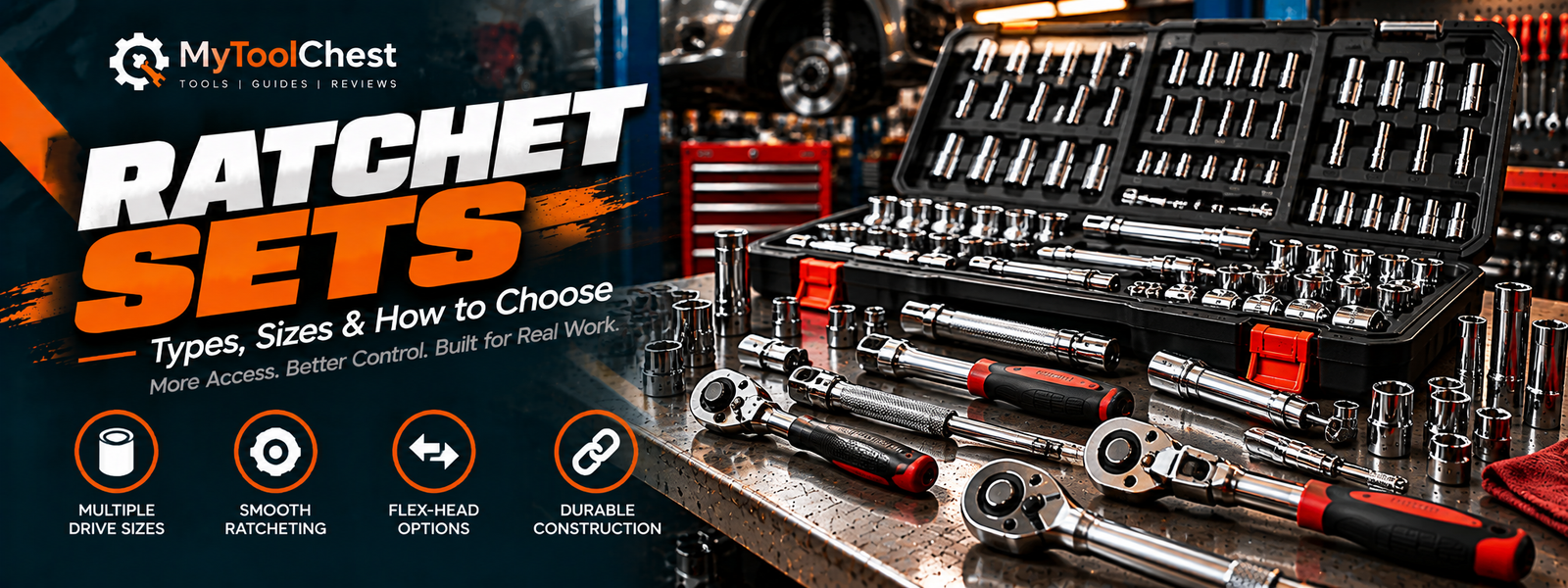
Ratchet Sets: Types, Sizes & How to Choose
A ratchet set pairs a ratcheting handle with interchangeable sockets to turn fasteners faster than a fixed wrench. Drive size, tooth mechanism, handle design, and socket compatibility all shape how a set performs in real work.
This is an educational guide to how ratchets work, the common types you will encounter, and what to check before choosing a setup.
On This Page
Jump straight to the section you need. Every link scrolls to a section on this page.
Types of Ratchet Sets
Ratchets differ mainly in head design, handle length, and the release mechanism. Each trade-off suits a different kind of work.
Standard Socket Ratchet Sets
The everyday baseline
Handle paired with a set of sockets across one or more drive sizes. Covers general automotive and mechanical work. Limited by head profile in very tight spaces.
Flex-Head Ratchet Sets
Pivoting head
The head pivots on a hinge, letting the handle swing off-axis to reach fasteners around obstacles. Adds a moving joint that can wear over time, and the head may feel less rigid than a fixed design.
Stubby Ratchets
Short handle, tight access
A very short handle for confined spaces. The trade-off is less leverage, so stubby ratchets are not suited to stubborn or high-torque fasteners.
Long-Handle Ratchets
Extra leverage
Longer handles increase leverage for stubborn fasteners, but the added length requires more clearance. Not ideal in tight spaces or under a dashboard.
Reversible Ratchets
Direction selector
A lever or dial reverses the ratchet direction without removing the socket. Common in most modern sets. The selector position can be knocked during use if not locked in place.
Quick-Release Ratchets
Button release
A push button on the head releases the socket quickly. Speeds up socket changes and prevents sockets from staying stuck. Adds one small mechanism that benefits from occasional cleaning.
Fine-Tooth Ratchets
Higher tooth count
More teeth on the gear mean a shorter swing arc to engage the next tooth. Useful in tight spaces. Not automatically stronger than a coarser mechanism — tooth count is one factor, not a full measure of quality.
Compact Ratchet Sets
Small format kits
Smaller handles and cases with focused size coverage. Common for interior work, motorcycles, and travel kits. Limited leverage and size range.
Many ratchets combine features — for example, a reversible flex-head with quick release. Design choices stack, so it helps to identify the features you need before comparing options.
Common Ratchet Drive Sizes
Drive size refers to the square fitting where the socket attaches. Each size suits a different range of fasteners and workspaces.
Small Fasteners & Tight Access
Suited to interior trim, small engine work, and confined areas. Limited by lower leverage than larger drives.
Everyday General Use
A versatile middle ground for automotive and general mechanical work. Balances access with useful leverage.
Larger Fasteners
Used for suspension, chassis, and higher-torque applications. Longer handles and larger sockets, with less access in tight spaces.
| Drive Size | Typical Applications | Common Advantages | Limitations | Factors to Consider |
|---|---|---|---|---|
| 1/4-inch | Interior trim, small fasteners, tight access | Compact head, easy to handle in confined areas | Limited leverage for stubborn or larger fasteners | Socket range, head profile, and swing arc |
| 3/8-inch | General automotive and mechanical work | Balanced leverage and access for most tasks | Not suited to all larger or very tight fasteners | Handle length, tooth count, socket depth |
| 1/2-inch | Larger fasteners, suspension, chassis work | More leverage and larger socket compatibility | Bulkier head, less access in tight spaces | Socket range, handle length, clearance |
Follow the tool and fastener manufacturer’s load and safety instructions. Drive size alone does not determine safe working limits for any specific fastener.
How a Ratchet Mechanism Works
A ratchet turns a fastener in one direction and slips freely in the other. That slip is what lets you keep tightening without lifting the tool off the nut.
-
Ratchet gear and pawl
A toothed gear sits inside the head. A spring-loaded pawl engages the teeth in one direction, transferring force to the socket. In the other direction, the pawl rides over the teeth, letting the handle return without turning the fastener.
-
Drive square
The square fitting protruding from the head is where the socket attaches. Its size (1/4", 3/8", 1/2", and larger) must match the socket.
-
Direction selector
A lever or dial sets the pawl to engage forward or reverse. Most modern ratchets reverse without removing the socket from the fastener.
-
Handle and leverage
The handle provides leverage. Longer handles increase turning force at the fastener but require more clearance to swing.
-
Working stroke vs. return stroke
The working stroke turns the fastener. The return stroke resets the handle without turning the fastener, so the wrench can engage the next tooth.
-
Quick-release button
Some ratchets include a push-button release that ejects the socket. Useful when sockets stick, but adds a small mechanism that benefits from occasional cleaning.
Tooth Count and Swing Arc
Tooth count and swing arc are related. Higher tooth counts reduce how far the handle must move before the next tooth engages.
Lower Tooth Count
Fewer, larger teeth mean a longer swing is needed before the pawl catches the next tooth. Handle must travel further in tight spaces.
Higher Tooth Count
Finer teeth engage sooner, so the handle needs less movement to advance. Useful where clearance is limited. Tooth count is one factor among several and does not by itself determine tool quality.
Follow the manufacturer’s guidance on load limits and intended use. Tooth count alone is not a reliable measure of strength or durability.
Flex-Head vs. Fixed-Head Ratchets
The difference is in the head joint. Flex-heads add positioning options; fixed-heads stay simpler and more rigid.
Flex-Head Ratchet
- Head pivots to reach around obstacles
- Handle can swing off-axis
- Helpful where straight access is blocked
- Adds a moving joint that can wear
- May feel slightly less rigid under load
- Best where positioning is the constraint
Fixed-Head Ratchet
- Head stays aligned with the handle
- Simpler mechanism
- Feels more rigid under steady load
- Less adaptable around obstacles
- Fewer parts to maintain
- Best for straight-on access
Ratchet vs. Socket Wrench
Terminology overlaps in this category. These are the practical differences between the tools people usually mean.
Ratchet Handle
A handle with an internal ratcheting mechanism and a square drive that accepts interchangeable sockets. Turns a fastener in one direction and slips in the other, so the socket does not need to be lifted between strokes.
Fixed Socket Tool
A non-ratcheting tool with a socket or box-end permanently attached. Turns a fastener by rotating the handle or the tool body. No slip mechanism — every turn moves the fastener.
Ratcheting Combination Wrench
A wrench with an open end on one side and a ratcheting box end on the other. Different tool class from a socket ratchet, though it shares the ratcheting concept. Common in general mechanical work.
Terms like “socket wrench” and “ratchet” are used differently by region and manufacturer. Compare the actual design rather than the label.
How to Choose a Ratchet Set
Match the ratchet to the work, the space, and the sockets you already own. This checklist covers the factors that matter most.
- Drive size compatibility Start with the sockets you already own or plan to use. The ratchet drive must match.
- Required socket range Confirm the size range you need — small fasteners only, or larger sizes as well.
- Metric vs. SAE needs Match the size system to your vehicle or equipment. The two are not interchangeable.
- Handle length & clearance Longer handles mean more leverage but also more swing room. Check the space you actually work in.
- Fixed-head vs. flex-head Choose flex when access is the limiting factor; fixed when you want a simpler, more rigid feel.
- Tooth mechanism & arc Finer teeth help where the handle cannot swing far. Match the mechanism to the workspace.
- Quick-release & reversible Both features speed up work. Decide whether the added mechanism is worth it for your tasks.
- Extension & adapter fit Extensions, universal joints, and adapters must match the drive size of the ratchet.
- Grip & maintenance A comfortable handle reduces fatigue. A mechanism you can keep clean will last longer.
- Intended workload Follow the manufacturer’s guidance for the tool you choose. Match the tool to the job rather than the other way around.
Choose based on your tasks, not on piece count or marketing claims. A well-matched ratchet for your work is worth more than a set with extra pieces you will not use.
Safe Use and Maintenance
Ratchet mechanisms are precise. A few habits keep them working and reduce the risk of damage or injury.
A socket that does not fit properly can slip and round the fastener. Match the socket to the nut or bolt.
Push the socket onto the drive square until it clicks or seats completely. A partially engaged socket can slip under load.
Wipe the head and drive square after use. Follow the manufacturer’s guidance if lubrication is recommended.
Straining a small mechanism can damage the pawl or gear. Use a breaker bar or a larger drive for stubborn fasteners when appropriate.
Unless the manufacturer explicitly permits it, do not use a ratchet where a breaker bar is the correct tool.
Cheater bars, pipe extensions, and improvised handle add-ons exceed the tool’s design and can cause failure.
Impact wrenches require impact-rated sockets and accessories. Do not use hand-tool sockets on power impact tools.
Load limits, intended use, and maintenance intervals are set by the manufacturer. Read the instructions that come with the tool.
Common Mistakes
- Choosing a drive size without considering the task. A 1/4" ratchet cannot replace a 1/2" one on larger fasteners. Match the drive size to the work.
- Ignoring socket compatibility. Sockets, extensions, and adapters must match the ratchet’s drive size. Mismatched accessories do not fit properly.
- Assuming tooth count alone determines quality. Tooth count affects swing arc, not overall strength or durability. Consider the full design.
- Using a ratchet without enough clearance. A handle that cannot swing freely cannot engage the next tooth. Check the space before choosing a handle length.
- Applying excessive force to a small mechanism. Straining a ratchet can damage the pawl. Use the correct tool for the torque required.
- Neglecting cleaning and maintenance. Debris inside the head can affect engagement. A quick wipe-down and periodic attention keep the mechanism working.
- Using tools outside their intended application. Hand ratchets are not for use with impact tools unless impact-rated. Follow the manufacturer’s guidance.
- Ignoring manufacturer safety instructions. Load limits and maintenance intervals are set for a reason. Read the instructions that come with the tool.
Related Guides
Educational guides that go deeper on related tool categories.
Tool Sets Hub
The main hub for tool set types, uses, and buying guides.
Best Mechanic Tool Sets
Broad automotive and shop coverage in one organized case.
Best Socket Sets
Drive sizes, size coverage, and ratchet-ready layouts.
Best Impact Socket Sets
Impact-rated sockets for use with impact wrenches and drivers.
Best Combination Wrench Sets
Open-end and box-end coverage for turning and holding.
Best Automotive Tool Kits
Portable kits for vehicle maintenance and roadside needs.
Frequently Asked Questions
What is a ratchet set?
A ratchet set combines a ratcheting handle with a group of interchangeable sockets, usually across one or more drive sizes. The ratchet turns a fastener in one direction and slips in the other, so the socket does not need to be lifted between strokes.
What are the common ratchet drive sizes?
The common drive sizes are 1/4-inch, 3/8-inch, and 1/2-inch. Each suits a different range of fasteners and workspaces. Some sets include all three to cover a wider range of work.
Is a 3/8-inch drive ratchet suitable for general use?
3/8-inch is often the most versatile single drive size for general automotive and mechanical work. It balances leverage with access in a wide range of tasks, which is why many general-purpose sets center on it.
What is the difference between a flex-head and fixed-head ratchet?
A flex-head ratchet has a pivoting joint at the head, which lets the handle swing off-axis to reach around obstacles. A fixed-head ratchet keeps the head aligned with the handle, which feels more rigid but offers less positioning flexibility.
Does a higher tooth count always mean a better ratchet?
No. A higher tooth count gives a shorter swing arc, which helps in tight spaces. Tooth count is one factor among several and does not by itself determine overall quality, strength, or durability. Consider the mechanism and construction together.
What is the difference between a ratchet and a socket wrench?
The terms overlap. A ratchet handle has an internal ratcheting mechanism and accepts interchangeable sockets. A fixed socket tool has the socket or box-end permanently attached. A ratcheting combination wrench is a different class, with a ratcheting box end on one side. Terminology varies by region and manufacturer.
Can a ratchet be used with an impact wrench?
No. Impact wrenches require impact-rated sockets and accessories. Hand-tool sockets and standard ratchets are not intended for impact use unless the manufacturer explicitly confirms compatibility. Follow the manufacturer’s guidance.
How should I maintain a ratchet mechanism?
Wipe the head and drive square after use, keep debris out of the mechanism, and follow the manufacturer’s guidance if lubrication is recommended. Avoid using the ratchet as a breaker bar, and do not add improvised extensions to the handle.
Understand Your Tools. Work with Confidence.
Knowing how a ratchet works, which drive sizes suit your work, and where each head design helps makes every job faster and safer. Use the related guides below to explore the tool categories that go with a ratchet set.