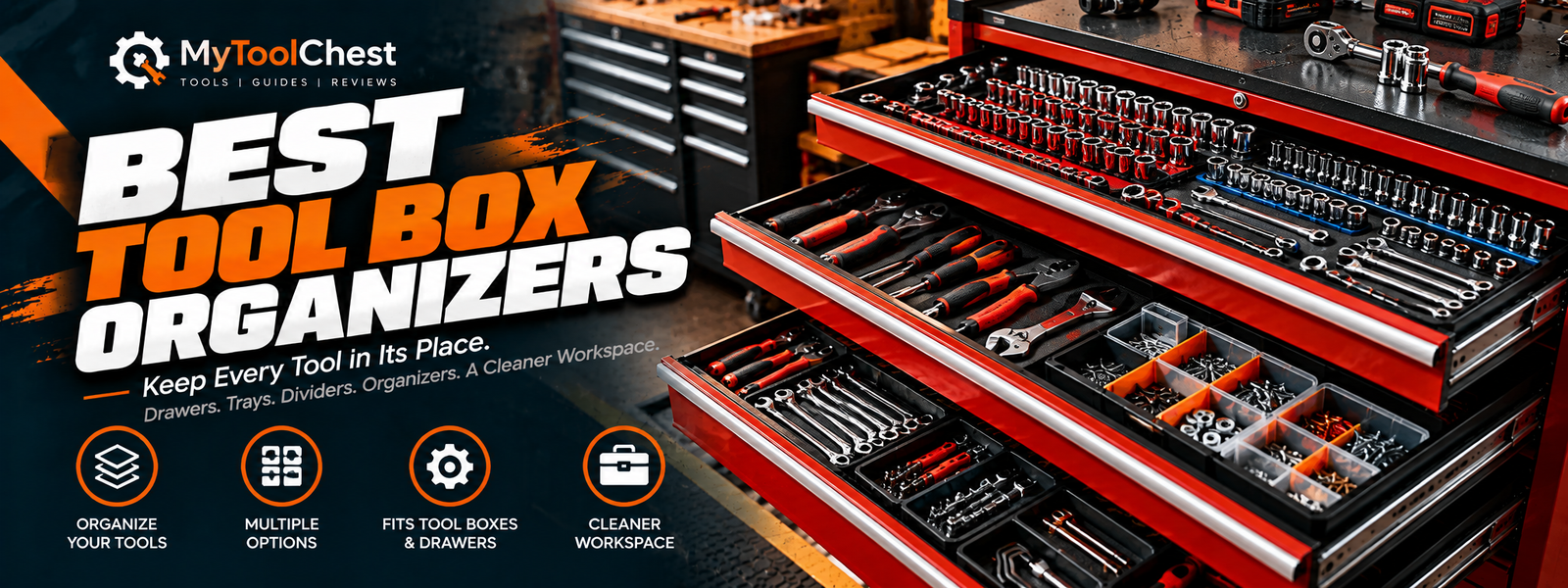
Best Tool Box Organizers: Keep Every Tool in Its Place
A tool box organizer is often the cheapest way to fix a cluttered setup. Trays, inserts, dividers, and socket rails bring structure to a box you already own — tools stop shifting, small parts stop mixing, and frequently used items stay within reach.
This guide covers the main types of organizers, what to compare before buying, and how to match the layout to the tools you actually store.
Quick Picks by Category
These editorial categories cover the most common ways readers shop for tool box organizers. Product details are added after verification.
[Product Name — Verify]
Best for: General tool box setup
Key specs: [Dimensions, material, compartment count — verify]
- Pros: [Verify]
- Cons: [Verify]
[Product Name — Verify]
Best for: Tool drawers
Key specs: [Dimensions, material, compartment count — verify]
- Pros: [Verify]
- Cons: [Verify]
[Product Name — Verify]
Best for: Socket storage
Key specs: [Drive size, socket count, material — verify]
- Pros: [Verify]
- Cons: [Verify]
[Product Name — Verify]
Best for: Flexible layouts
Key specs: [Length, divider count, material — verify]
- Pros: [Verify]
- Cons: [Verify]
[Product Name — Verify]
Best for: Fasteners & bits
Key specs: [Dimensions, compartment count — verify]
- Pros: [Verify]
- Cons: [Verify]
[Product Name — Verify]
Best for: Carry boxes
Key specs: [Dimensions, weight, material — verify]
- Pros: [Verify]
- Cons: [Verify]
[Product Name — Verify]
Best for: Entry-level setup
Key specs: [Dimensions, compartment count, material — verify]
- Pros: [Verify]
- Cons: [Verify]
Compare Tool Box Organizers at a Glance
A general framework. Fill in verified product details once research is complete.
| Organizer | Best For | Organizer Type | Material | Dimensions | Compatibility | Price Range |
|---|---|---|---|---|---|---|
| [Product — verify] | General setup | Modular tray | [Verify] | [Verify] | [Drawer fit — verify] | [Verify] |
| [Product — verify] | Tool drawers | Drawer insert | [Verify] | [Verify] | [Verify] | [Verify] |
| [Product — verify] | Socket storage | Socket rail | [Verify] | [Verify] | [Drive size — verify] | [Verify] |
| [Product — verify] | Flexible layouts | Adjustable dividers | [Verify] | [Verify] | [Verify] | [Verify] |
| [Product — verify] | Small parts | Compartment organizer | [Verify] | [Verify] | [Verify] | [Verify] |
Types of Tool Box Organizers
Organizers differ mainly in material, adjustability, and what they are designed to hold. Understanding the trade-offs helps you decide what to prioritize.
Foam Tool Inserts
Custom-fit drawer layouts
Foam cutouts hold tools in place with precise fit. Durable and clean-looking, but requires measurement and may not suit growing collections.
Socket Organizers & Rails
Socket and ratchet storage
Rails and holders keep sockets in order by drive size and measurement system. Compact and easy to lift out of the box.
Adjustable Drawer Dividers
Flexible drawer layouts
Move or remove dividers as tools change. Useful when the collection is still growing or the drawer needs to hold mixed items.
Modular Tool Trays
Reconfigurable drawer storage
Linkable trays let you rearrange the layout inside the box. Good for mixed tool types and for keeping small parts separated.
Small-Parts Organizers
Fasteners, bits, adapters
Many small compartments keep hardware separated. Often sold as a standalone case that drops into a larger drawer.
Portable Organizer Inserts
Carry boxes and cases
Lightweight trays that lift in and out of a portable box. Keeps tools sorted while travelling without adding much weight.
Magnetic Tool Holders
Quick access on metal surfaces
Magnetic strips and holders keep frequently used tools visible and reachable. Work best on steel cabinets or metal backsplash panels.
Custom Drawer Systems
Fully tailored layouts
Mixed dividers, trays, and inserts designed around a specific tool set. Highest fit but also the most effort to plan.
How to Choose the Best Tool Box Organizer
Fit and layout decide most organizer choices. These factors help you compare options on equal footing.
Tool Dimensions & Fit
Measure your longest, widest, and thickest tools. The organizer must hold them without forcing or leaving them loose.
Drawer Dimensions
Compare organizer length, width, and height against the drawer’s interior dimensions. Confirm the lid can still close if the box has one.
Fixed vs. Adjustable
Fixed compartments give a tidy, stable layout. Adjustable dividers adapt as tools change. Choose based on how settled your collection is.
Material
Foam protects and looks clean, plastic is affordable and light, metal is durable but heavier. Match material to how rough your shop use is.
Visibility & Access
Tools you can see are tools you use. Low-sided trays keep small items visible; deep bins hide them.
Socket & Wrench Sizing
Rails and holders come in specific drive sizes and measurement systems. Confirm metric or SAE coverage before buying.
Portability
If the organizer travels with the box, weight and how firmly it stays in place matter. Trays that lift out easily can also slide out when you do not want them to.
Oil, Dust & Cleaning
Workshop environments are messy. Smooth plastic and closed-cell foam clean up faster than open-cell foam or fabric liners.
System Compatibility
Some organizers link into modular systems; others are standalone. Check whether they work with the box or chest you already own.
Budget & Value
Organizers are usually cheap, but poor fit wastes the purchase. A slightly pricier option that fits well tends to serve longer than a cheaper mismatch.
Measure your drawer and your tools before buying an organizer insert. Most returns come down to fit, not quality.
Organization Ideas by Tool Type
Different tools call for different layouts. These approaches tend to work well across most boxes.
Sockets & Ratchets
Group sockets by drive size first, then by measurement system, then by size order. Rails and holders keep the sequence intact and make missing sizes obvious at a glance.
Wrenches & Pliers
Sort wrenches by size and type, and keep pliers grouped by function. Frequently used pliers benefit from a dedicated slot rather than sharing a mixed tray.
Screwdrivers & Bits
Vertical holders make drivers easy to grab. Bits and small accessories stay sorted in a shallow multi-compartment tray next to the drivers.
Small Parts & Accessories
Fasteners, adapters, and small components mix easily. A multi-compartment case with a tight lid prevents spillage when the box moves.
General Hand Tools
Dividers keep tools from sliding into a pile. Group by task so the tools you reach for together end up stored together.
Mixed Layouts
Many boxes end up holding a mix of tool types. In that case, layer the layout: heavy and bulky items low, small parts in shallow trays, frequently used tools up top.
No single organization system suits every tool box. The right layout depends on the tools you store and how often you use them.
Fixed vs. Adjustable Organizers
Both approaches work, but they suit different situations. The choice usually comes down to how settled your tool collection is.
Fixed Organizers
- Custom-fit foam cutouts or molded inserts
- Precise layout with no shifting
- Clean, professional look
- Difficult to rearrange when tools change
- Best for stable, well-defined tool sets
- Limited compatibility with other boxes
Adjustable Organizers
- Movable dividers and modular trays
- Reconfigurable as the collection grows
- Less precise fit for odd-shaped tools
- Small parts may shift if dividers are loose
- Best for evolving or mixed tool sets
- Easier to move between boxes
Many setups combine both: fixed inserts for core tools, adjustable trays for accessories that change with each job.
Common Buying Mistakes
- Buying an organizer without measuring the drawer. Length, width, and depth all matter, and a lid that will not close is a common return reason. Measure first.
- Ignoring the size and shape of the tools. A tray that fits the drawer may still not hold your largest wrench or thickest pliers without forcing.
- Choosing compartments that do not fit the accessories. Compartments too small for sockets or too large for bits waste space. Match compartment size to what you plan to store.
- Overlooking compatibility with the existing storage. Not every organizer fits every box. Check whether it works with the box or chest you already own.
- Buying more compartments than necessary. More compartments is not automatically better. Too many small slots can make tools harder to grab.
- Ignoring material durability and cleaning. Open-cell foam traps oil and dust; thin plastic cracks under load. Choose material that suits your shop environment.
- Assuming every organizer fits every tool box. Sizes and mounting systems vary. Confirm fit or check whether the organizer is designed for your specific box type.
Related Buying Guides
Each guide goes deeper on one storage type. Pick the one closest to your setup.
Best Tool Boxes
The main buying guide covering portable, metal, drawer, and rolling boxes.
Read the guideBest Tool Chests
Drawer-based chests and rolling cabinets for workshop use.
Compare chestsBest Portable Tool Boxes
Carry-ready storage for jobs away from the bench.
See portable optionsBest Rolling Tool Boxes
Wheeled storage for heavy loads and frequent transport.
See rolling optionsTool Boxes with Drawers
Sorted, easy-access layouts for growing collections.
Explore designsBest Hand Tools
The everyday hand tools that fill out a working collection.
Read the guideTool Boxes Hub
The main hub for tool storage types, guides, and comparisons.
Open the hubFrequently Asked Questions
What is the best tool box organizer?
There is no single best organizer. The right one depends on your box, your drawer dimensions, and the tools you store. Focus on fit, material, and layout rather than looking for a universal pick.
How do I organize a tool box efficiently?
Group tools by task, keep frequently used items on the top layer, and use trays or dividers for small parts. Heavy tools belong lower. Rearrange the layout after a week of use if something feels awkward.
Are foam tool inserts worth it?
They can be, especially for stable tool sets where a clean, precise layout matters. Foam holds tools in place, resists shifting, and looks professional. The trade-off is that adding or swapping tools usually means a new insert.
How do I choose the right socket organizer?
Start with your drive size — 1/4-inch, 3/8-inch, and 1/2-inch are the common ones — then confirm the rail or holder matches the sockets you have. Check whether it covers both metric and SAE, and whether it fits in the drawer you plan to use.
Are adjustable drawer dividers better than fixed inserts?
Neither is universally better. Adjustable dividers adapt as tools change and are easier to move between boxes. Fixed inserts give a cleaner, more stable layout but do not reconfigure. Match the choice to how settled your collection is.
How do I measure a drawer for an organizer?
Measure the inside length and width of the drawer, then the inside height. Add up the depth of the organizer plus the tallest tool it will hold, and confirm the lid or drawer above can still close. Measure twice; returns almost always come down to fit.
Can tool organizers fit different tool boxes?
Some can, especially modular trays and adjustable dividers that are sized in standard increments. Others are designed for one box type. Check dimensions and mounting style before assuming an organizer will fit a box you already own.
How should I organize small parts and accessories?
Use a multi-compartment case with a tight lid. Sort fasteners and small parts by type or size, label if useful, and store the case somewhere the contents cannot tip. A shallow tray next to the tool drawer keeps the most-used items close at hand.
Product Data Verification
This guide currently uses placeholders for product names, specifications, and retailer links.
Before Publishing
- Replace every [Verify before publication] field with confirmed product details.
- Confirm each product still exists and matches its category.
- Verify retailer links resolve and point to the correct listing.
- Confirm specifications match the manufacturer’s current published data.
- Do not publish prices, ratings, or test results that have not been verified.
Build a Cleaner, More Organized Tool Box
An organizer earns its place when tools stay sorted, small parts stop mixing, and the layout matches the work you do. Measure the drawer, match compartment sizes to your tools, and choose fixed or adjustable based on how settled your collection is. Then use the related guides below to compare specific storage types.