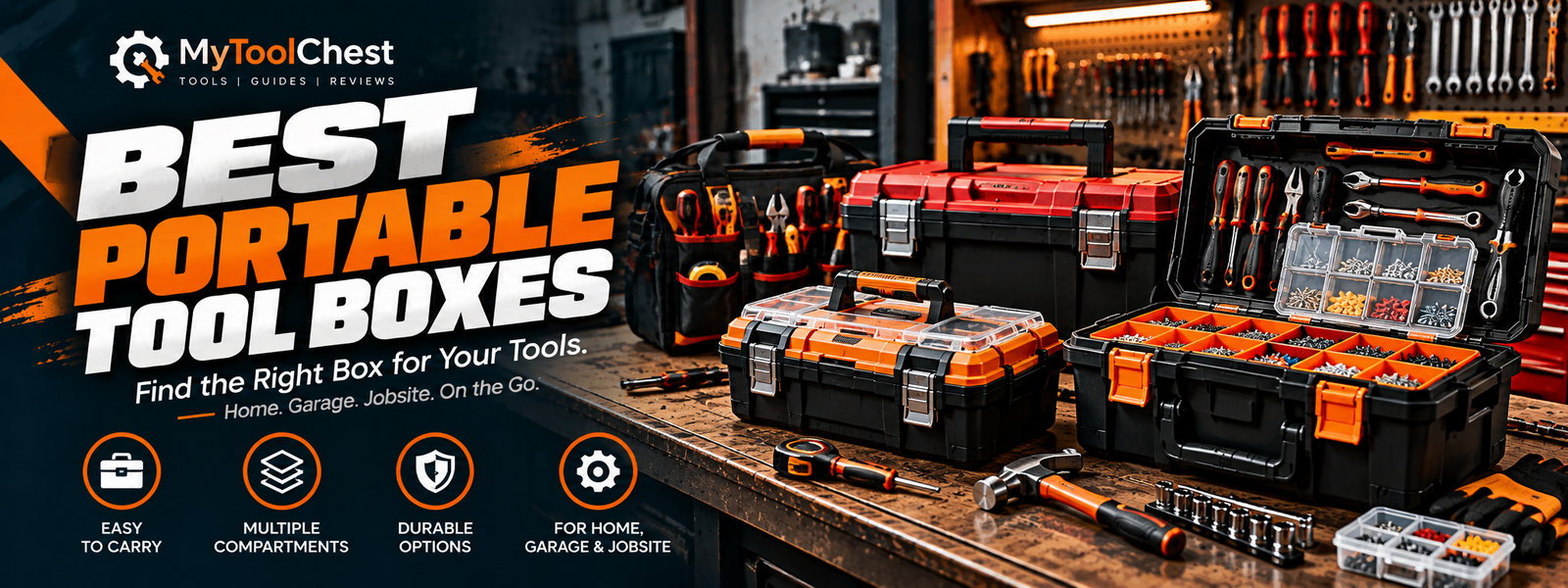
Best Portable Tool Boxes: Find the Right Box for Your Tools
A portable tool box is built for movement. Whether you carry tools between a garage, a truck, and a jobsite, or you just need a compact way to keep household tools together, the right box matches your collection size, your carrying comfort, and how you organize your tools.
This guide covers the main types of portable tool boxes, what to compare before buying, and how portable storage differs from tool bags and tool chests.
Quick Picks by Category
These editorial categories cover the most common ways readers shop for portable tool storage. Product details are added after verification.
[Product Name — Verify]
Best for: Everyday carry
Key specs: [Dimensions, material, tray count — verify]
- Pros: [Verify]
- Cons: [Verify]
[Product Name — Verify]
Best for: Light-duty use
Key specs: [Dimensions, material, tray count — verify]
- Pros: [Verify]
- Cons: [Verify]
[Product Name — Verify]
Best for: Tough use
Key specs: [Dimensions, material, load rating — verify]
- Pros: [Verify]
- Cons: [Verify]
[Product Name — Verify]
Best for: Small tool sets
Key specs: [Dimensions, material, tray count — verify]
- Pros: [Verify]
- Cons: [Verify]
[Product Name — Verify]
Best for: Sorted storage
Key specs: [Dimensions, compartment count — verify]
- Pros: [Verify]
- Cons: [Verify]
[Product Name — Verify]
Best for: Auto maintenance
Key specs: [Dimensions, tray layout, material — verify]
- Pros: [Verify]
- Cons: [Verify]
[Product Name — Verify]
Best for: Home repairs
Key specs: [Dimensions, material, tray count — verify]
- Pros: [Verify]
- Cons: [Verify]
Compare Portable Tool Boxes at a Glance
A general framework. Fill in verified product details once research is complete.
| Product | Best For | Material | Dimensions | Storage Layout | Carrying Features | Price Range |
|---|---|---|---|---|---|---|
| [Product — verify] | Everyday carry | [Verify] | [Verify] | Removable tray | Top handle | [Verify] |
| [Product — verify] | Light-duty use | [Verify] | [Verify] | Single compartment | Top handle | [Verify] |
| [Product — verify] | Heavy-duty use | [Verify] | [Verify] | Multi-tray | Reinforced handle | [Verify] |
| [Product — verify] | Small collections | [Verify] | [Verify] | Single compartment | Compact handle | [Verify] |
| [Product — verify] | Sorted storage | [Verify] | [Verify] | Multiple compartments | Top handle | [Verify] |
Types of Portable Tool Boxes
Portable boxes differ mainly in size, material, and how they organize tools. Understanding the trade-offs helps you decide what to prioritize.
Compact Tool Boxes
Small collections
Small footprint, easy to store on a shelf. Ideal when you only need a handful of everyday tools within reach.
Heavy-Duty Portable Boxes
Tough environments
Reinforced frames and stronger latches for frequent transport. Heavier than standard boxes but built to last.
Plastic Tool Boxes
Home and light use
Light, rust-free, and typically cheaper. Less rigid than steel, so heavy loads can stress hinges and latches.
Metal Tool Boxes
Rough use
Rigid and impact-resistant, with a sturdy lid. Heavier than plastic and finish quality affects rust resistance.
Portable Organizers
Small parts and hardware
Removable compartments keep fasteners, bits, and small tools sorted. Ideal as a companion box to a larger setup.
Multi-Tier Tool Boxes
Structured storage
Stacked trays or folding tiers keep tools visible and separated. Good for users who want a full layout in a small footprint.
Boxes with Removable Trays
Flexible layouts
Lift-out trays let you reach lower layers without unpacking. Useful when tools change by job or project.
Vehicle Maintenance Boxes
Trucks and roadside kits
Sized to fit under seats or in trunks, often with snug compartments to keep tools from shifting during transport.
How to Choose the Best Portable Tool Box
Carrying comfort, real capacity, and useful organization matter more than appearance alone. These factors decide most choices.
Dimensions & Usable Capacity
Interior space matters more than outside size. Measure your longest tools and check that they actually fit.
Empty vs. Loaded Weight
A box that feels fine empty can be heavy when full. Think about how far you carry it and how often.
Handle Comfort
A padded or molded handle helps if you carry the box for more than a few steps. Check grip and balance.
Material & Build
Plastic is light and rust-free; steel is rigid but heavier. Look at welds, seams, and finish quality.
Latches & Hinges
Latches and hinges wear before the body does. Check how firmly the lid closes and whether it stays closed when carried.
Trays & Organization
Removable trays and compartments keep tools sorted. Match the layout to how you work.
Dust & Moisture Resistance
Not every box protects equally. If you work outdoors or in a dusty shop, check lid seals and closures.
Mobility & Fit
Check that the box fits your vehicle, shelf, or storage spot. A box that does not fit ends up sitting unused.
Locking & Security
A lock deters casual access but is not a guarantee. Consider the environment where the box will live.
Budget & Long-Term Value
The cheapest box can cost more if latches fail. Consider warranty and whether it can grow with your tools.
Looking for storage that stays in one place? Our tool chests guide covers drawer-based workshop storage.
Recommendations by Use Case
The right portable box changes with the user. These notes describe direction, not specific picks.
DIY Homeowners
A compact or mid-size box with a removable tray keeps everyday household tools reachable without clutter. Prioritize easy access.
Automotive Enthusiasts
Look for a box with shallow tray layouts that fit sockets and wrenches, plus enough depth for extensions. Vehicle-friendly dimensions matter.
Professional Tradespeople
Durability, secure latches, and confident closure matter when a box travels daily. Reinforced handles and hinges are worth the extra weight.
Small Tool Collections
A compact box with a removable tray handles a starter collection well. Keep dimensions modest so it stores easily on a shelf.
Jobsite Use
Carrying comfort and organization matter more than total capacity. Check whether the box suits the environment — dust, moisture, and rough handling included.
Vehicle Storage
Measure the space first, then pick a box that fits snugly. Compartments that hold tools in place reduce shifting during transport.
Portable Tool Box vs. Tool Bag vs. Tool Chest
Three storage formats, three different jobs. The right one depends on how you carry and store tools.
Portable Tool Box
- Structured storage with rigid walls
- Moderate capacity for hand tools
- Good protection for tools inside
- Trays and compartments organize tools
- Quick access with a lift lid
- Best for carry-and-store setups
Tool Bag
- Soft-sided and flexible
- Adapts to irregular tool shapes
- Moderate protection, less rigidity
- Many pockets and loops
- Easy access through open top
- Best for users who prefer flexible compartments
Tool Chest
- Drawer-based and typically stationary
- High capacity for large collections
- Strong protection for stored tools
- Drawers sort tools by type
- Reach-in access from each drawer
- Best for workshop home bases
Common Buying Mistakes
- Choosing a box that is too small. Tools rarely shrink. If your current set already fills the box, you will be shopping again soon.
- Ignoring the weight of a fully loaded box. A box that feels fine empty can be heavy when full. Think about stairs, vehicles, and shelf heights.
- Buying based on piece count or looks. Weak latches, thin hinges, and thin plastic bodies fail early. Compare construction, not just styling.
- Overlooking handle comfort and latch quality. These are the parts you touch every time you use the box. They matter more than most shoppers expect.
- Choosing compartments that do not fit your tools. Small trays do not hold long tools, and deep wells swallow small parts. Match layout to your tool types.
- Ignoring dimensions and vehicle space. A box that does not fit your truck or shelf ends up sitting unused. Measure first.
- Paying for features you do not need. Locking, reinforced frames, and specialty trays add cost. Only pay for what your setup uses.
- Assuming all portable boxes offer the same protection. Dust, moisture, and impact resistance vary widely. Check lid seals and closures if your environment is rough.
Related Buying Guides
Each guide goes deeper on one storage type. Pick the one closest to your setup.
Best Tool Boxes
The main buying guide covering portable, metal, drawer, and rolling boxes.
Read the guideBest Tool Chests
Drawer-based chests and rolling cabinets for workshop use.
Compare chestsBest Rolling Tool Boxes
Wheeled storage for heavy loads and frequent transport.
See rolling optionsTool Boxes with Drawers
Sorted, easy-access layouts for growing tool collections.
Explore designsTool Box Organizers
Trays, inserts, and bins for tidying a box you already own.
Find organizersBest Tool Bags
Soft-sided carry options for tools that do not fit a rigid box.
Compare tool bagsTool Boxes Hub
The main hub for tool storage types, guides, and comparisons.
Open the hubFrequently Asked Questions
What is the best portable tool box?
There is no single best box for everyone. The right one depends on your tool collection, how far you carry the box, and how you like to organize tools. Match dimensions, weight, and layout to your actual use rather than to marketing claims.
What should I look for in a portable tool box?
Check interior dimensions, loaded weight, handle comfort, latch and hinge quality, and whether the tray layout fits your tools. If you work outdoors, also check dust and moisture resistance. Construction quality tends to matter more than appearance.
Are plastic or metal tool boxes better?
Neither wins universally. Plastic is lighter, rust-free, and usually cheaper, while metal is more rigid and impact-resistant but heavier. The better choice depends on your environment, how rough your use is, and how much weight you can comfortably carry.
What size portable tool box do I need?
Lay out the tools you plan to store, measure the longest and bulkiest ones, and compare those numbers with the box’s interior dimensions. Then confirm that the outside size fits your shelf, vehicle, or storage space. Leave a little room for growth.
Are removable trays useful?
They can be. Removable trays let you lift out an upper layer to reach lower tools without unpacking everything. They work well when you carry different sets of tools for different jobs, but they also reduce the usable depth of the box below the tray.
How much weight can a portable tool box hold?
That depends on the specific box. Load ratings vary widely by material, handle design, and latch quality. Check the manufacturer’s published specs for the box you are considering, and do not assume capacity from size alone.
Is a tool box or tool bag better for carrying tools?
A rigid tool box protects tools better and keeps them in fixed positions. A tool bag adapts to irregular tool shapes and is usually lighter when empty. If you carry a lot of odd-shaped tools, a bag may suit better. See our tool bags guide for details.
How should I organize a portable tool box?
Put the most-used tools on the top tray, keep smaller items in compartments so they do not shift, and use a tool box organizer if you need more separation. Rearrange based on what you reach for most often.
Product Data Verification
This guide currently uses placeholders for product names, specifications, and retailer links.
Before Publishing
- Replace every [Verify before publication] field with confirmed product details.
- Confirm each product still exists and matches its category.
- Verify retailer links resolve and point to the correct listing.
- Confirm specifications match the manufacturer’s current published data.
- Do not publish prices, ratings, or test results that have not been verified.
Keep Your Tools Organized and Ready to Go
A portable tool box earns its place when it carries the right tools comfortably and keeps them organized. Match the size to your collection, the material to your environment, and the layout to how you work. Then use the related guides below to compare specific storage types.