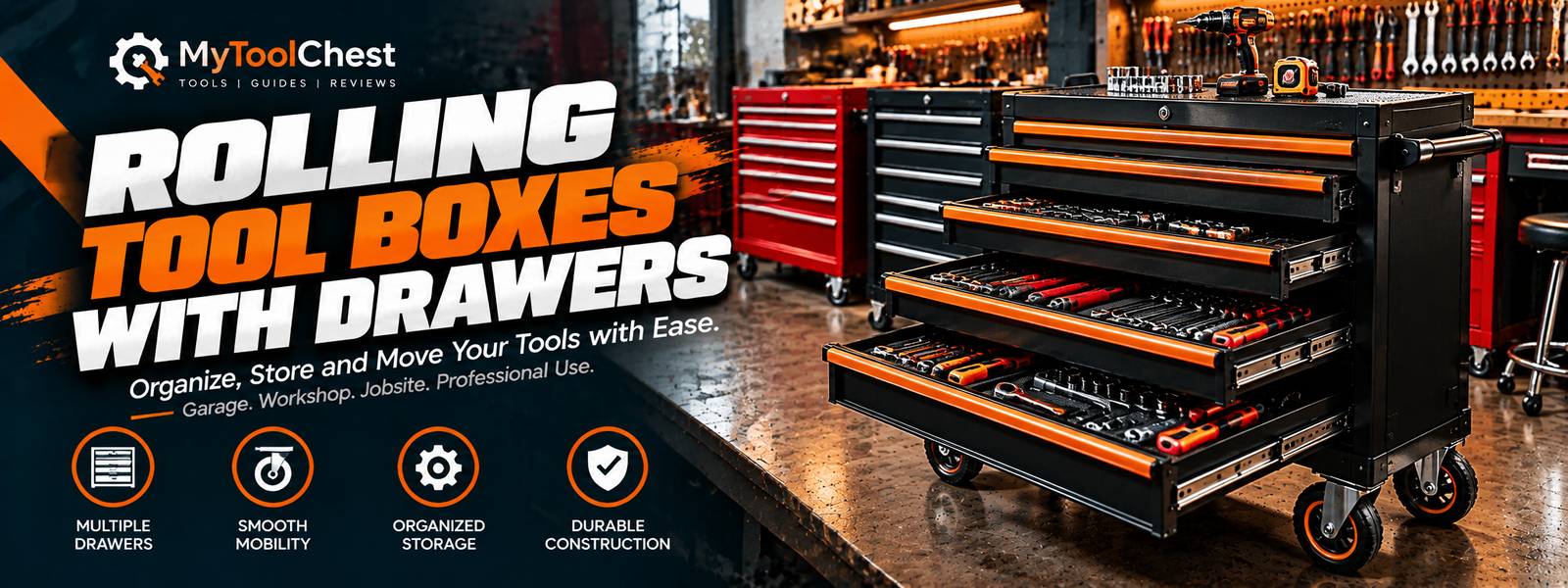
Best Tool Boxes With Drawers: Cabinets That Keep Every Tool in Its Place
The best tool boxes with drawers turn a pile of tools into an organised workshop. Instead of digging through a single deep box, you open a labelled drawer and the socket, spanner or screwdriver you need is right there. Drawer cabinets protect tools, save time and make it obvious when something is missing. This guide covers the types of drawer cabinets, how to choose, sizes and layouts, and who they suit — so you can pick a cabinet that fits your tools and your space.
What Is a Tool Box With Drawers?
A tool box with drawers is a chest or cabinet divided into shallow and deep drawers, each on its own slide, so tools are stored flat and visible rather than stacked. The most common form is the roller cabinet — a tall chest on castors — but drawer cabinets also come as bench-top chests, mid-size cabinets and stackable units. Most are steel, with ball-bearing drawer slides and a central lock that secures every drawer at once. For a broader overview of storage, see our tool boxes hub.
Drawers beat a single-compartment box for one simple reason: you can see everything. A socket set laid out in a shallow drawer is easy to find and easy to put back, while the same set loose in a deep box ends up in a jumble. That visibility is why professionals have used drawer cabinets for decades, and why they are the best choice once your tool collection outgrows a hand-carry box.
Types of Tool Boxes With Drawers
Bench-top drawer chests: a compact chest (usually 3 to 9 drawers) that sits on a workbench. Ideal for a small workshop or for the tools you reach for most, kept within arm’s reach. They are the most affordable way into drawer storage.
Roller cabinets: tall cabinets on castors, typically 5 to 15 drawers, that roll around the workshop. The standard for professional mechanics — see our best tool boxes for mechanics. Choose one with locking castors so it stays put while you work.
Stackable drawer units: modular chests that stack to build a taller cabinet over time. A good option if you want to start small and add drawers as your collection grows, or if you need to move the unit in sections.
Heavy-duty drawer chests: thicker steel, higher weight ratings and deeper drawers for large tools. Built for workshops where drawers are opened dozens of times a day and loaded with heavy sockets and wrenches. Our best metal tool boxes guide explains steel gauges.
Portable drawer boxes: smaller drawer cabinets with a carry handle, for taking a organised set to a job. A useful middle ground between a hand-carry box and a full cabinet — see best portable tool boxes.
How to Choose the Right Drawer Cabinet
Start by listing what will live in it. Count your socket sets, spanners, screwdrivers and pliers, and note the longest tools — they set the minimum drawer depth and width. Then measure your space: a roller cabinet needs floor space plus room to open drawers and to roll it out, while a bench-top chest only needs a clear stretch of bench.
Check the drawer slides. Ball-bearing slides open smoothly under load and last far longer than friction slides, especially on drawers that hold heavy sockets. Look for a weight rating per drawer (20 kg or more is a good baseline for a workshop cabinet) and make sure the rating is for the slides, not just the cabinet frame. A central lock that secures all drawers at once is worth having, and a keyed lock is better than a simple latch if the cabinet holds valuable tools.
Think about the finish and the top. A powder-coated steel cabinet resists rust and wipes clean, and a solid top (wood or rubber mat) gives you a work surface for laying out parts. Some cabinets include a built-in power strip or a side handle — useful extras, but not worth paying for if they compromise drawer space.
Sizes and Drawer Layouts
Cabinets are usually measured by width: narrow (around 650 mm), standard (around 900 mm) and wide (1,000 mm or more). A narrow cabinet suits a small garage; a standard width holds a full mechanic’s set; a wide cabinet suits a professional who needs many drawers. Height matters too — a tall cabinet holds more, but a shorter one doubles as a workbench if it has a solid top.
For drawer layouts, a mix of depths is most useful. Shallow drawers (50–75 mm) suit sockets, spanners, screwdrivers and small tools laid flat. Medium drawers (100–150 mm) suit pliers, hammers and power tool accessories. Deep drawers (200 mm or more) suit large wrenches, power tools and bulky items. Avoid a cabinet where every drawer is the same depth — it wastes space on small tools and cannot fit large ones. Add tool box organizers — foam inserts, socket rails and dividers — so each drawer stays tidy and a missing tool is obvious. If you move the cabinet often, see best rolling tool boxes for castor and mobility advice.
Drawer Slides, Weight Ratings and Build Quality
The slides are the part that wears out first, so they deserve attention. Ball-bearing slides use small steel balls to carry the load, so the drawer glides even when full. Friction slides rely on metal-on-metal contact, so they stick, wear and eventually jam under a heavy load. For any drawer that will hold sockets or wrenches, ball-bearing slides are worth the extra cost.
Check the weight rating per drawer and the gauge of the steel. A cabinet rated to 20–30 kg per drawer with 18-gauge steel will serve a home workshop for years; a professional cabinet should be 16 gauge with slides rated higher. Look at the drawer handles too — full-width handles are easier to grip with oily hands than small knobs, and a handle that doubles as a label holder keeps the cabinet organised.
Who Are Drawer Cabinets For?
Home mechanics: a mid-size roller cabinet or a bench-top chest is the single best upgrade from a hand-carry box. It organises a growing collection and makes every job faster, because you stop hunting for tools.
Professional mechanics: a wide, heavy-gauge roller cabinet with many drawers is the workshop standard. It holds a full professional set, locks securely overnight and rolls to the vehicle you are working on.
DIY and hobby users: a small bench-top chest with 3 to 5 drawers is enough for household repairs and occasional car work, and it costs far less than a full cabinet while still giving you the benefit of drawer organisation.
Shared workshops: a locking drawer cabinet keeps each person’s tools separate and secure, and labelled drawers mean anyone can find — and return — the right tool.
Common Mistakes to Avoid
- Buying too small. A cabinet that is full on day one has no room to grow. Leave at least one drawer empty for the tools you will add.
- Ignoring the slide rating. Overloading a drawer bends the slides and makes it stick. Spread heavy tools across drawers and keep the heaviest items in the lowest drawers.
- Choosing identical drawers. A cabinet where every drawer is the same depth wastes space. A mix of shallow, medium and deep drawers is far more useful.
- Skipping the lock. A drawer cabinet without a lock is an invitation in a shared space. A central lock that secures all drawers is a small price for peace of mind.
- Forgetting mobility. A full steel cabinet is very heavy. If you will move it, make sure it has sturdy castors with brakes — or choose a smaller unit.
Frequently Asked Questions
How many drawers do I need?
For a home workshop, 5 to 7 drawers is a good starting point. For a professional set, 10 or more drawers is common. More important than the count is the mix of depths — shallow for sockets, deep for large tools.
Are ball-bearing drawer slides worth it?
Yes. They open smoothly under load, last much longer than friction slides and make a real difference on drawers full of heavy sockets. They are the single most worthwhile upgrade on a drawer cabinet.
What is the best size for a tool cabinet?
For most home workshops, a standard-width cabinet (around 900 mm wide) with a mix of drawer depths is the best balance of capacity and floor space. Measure your workshop before you buy.
Can I add drawers to a cabinet later?
Only with stackable or modular units, which are designed to stack. A fixed roller cabinet cannot gain drawers, so buy with room to grow — or choose a stackable system if you expect your collection to expand.
For related guides, see our best tool chests, best metal tool boxes, best tool boxes for mechanics and the tool boxes hub.